

Where Material, Craft and Responsibility Meet
“Creativity has no limits, but our planet does.”
As an independent leather craftswoman and designer in Brussels, I believe that the value of an object begins with understanding its materials.
Where do they come from? What character do they carry? How can I use them with respect? And how can craftsmanship give them lasting meaning?
My approach is not about claiming perfection. It is about making considered choices: working on a small scale, selecting materials with care, valuing what already exists and creating pieces that are worth keeping, caring for, repairing and passing on.

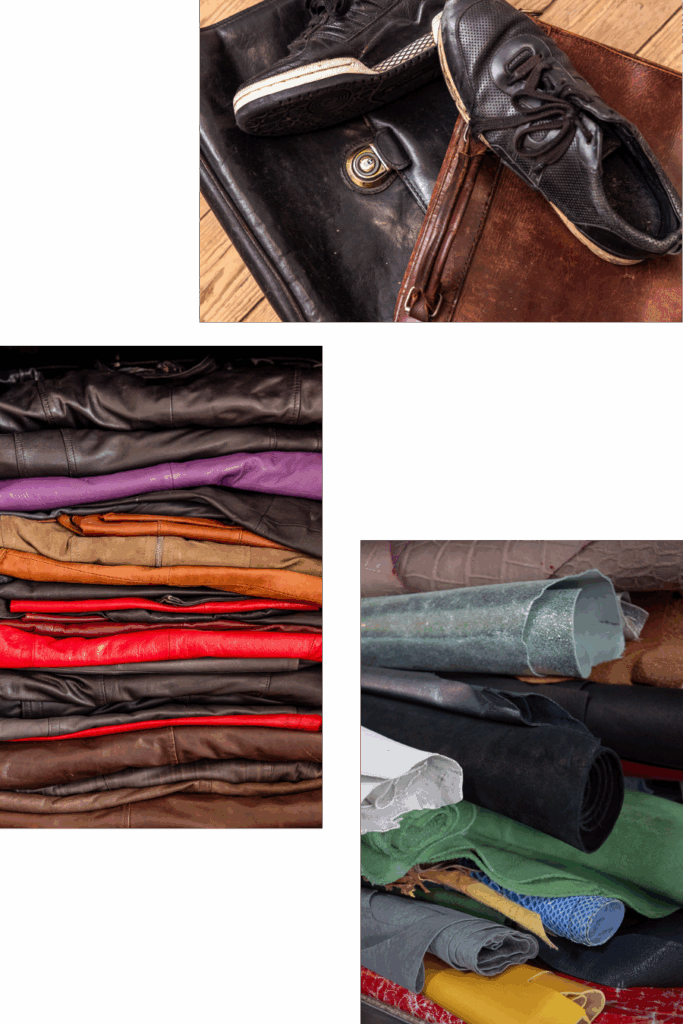
Leather goods
Respecting the Material
Every bespoke leather creation is handcrafted by me in my Brussels atelier.
Depending on the project, I work with:
- leather supplied by my clients, sometimes carrying a personal history of its own;
- carefully selected surplus and existing hides;
- new leather when the design, function or desired finish requires it.
I select each hide for its quality, character, feel and suitability for the individual project. Natural variations and traces are part of the material and can become part of the story of the finished piece.
Usable off-cuts are kept for smaller objects, details, prototypes or future creations.
Hardware is selected from specialised European suppliers for its quality, function and aesthetics. When appropriate, existing, vintage or surplus components can also become part of a new design.
I do not begin with the question of how much I can produce, but with what deserves to be created.
Each Composite is developed individually, in dialogue with the person for whom it is made. No seasonal collection dictates the design. Material, identity, function and craftsmanship come together in a one-of-a-kind creation.
📍 Recognised by COSH! as a more sustainable leather brand.
Discover how I create a bespoke leather CompositeClothing Collection
Bamboo Clothing: Designed in Brussels, Made in Europe
My clothing originates from the same fascination with material, form and identity.
Designed in Brussels and produced in small series with specialised partners in northern Portugal, the collection explores the softness, movement and sculptural possibilities of bamboo viscose.
Rather than presenting bamboo viscose as a perfect or impact-free material, I choose to focus on what I can know and experience directly: its tactile qualities, its behaviour in a garment and the people and expertise involved in transforming it.
The garments are developed outside the rhythm of rapidly changing seasonal collections. Each design is created to have its own identity and to remain relevant beyond a single season.


Why Bamboo Viscose?
I was drawn to bamboo viscose first and foremost as a designer and maker.
Its softness, drape and fluidity allow me to create silhouettes that move between clothing and wearable art. The material can fall softly around the body while also supporting the volumes and shapes that characterise my designs.
But choosing a material also means remaining curious about it. No material exists without an impact, and its origin is only one part of its story. Processing, craftsmanship, use, care and longevity matter too.
That awareness continues to shape the choices I make as my collection evolves.
Less about claiming the perfect material. More about understanding the material I choose to work with.
📍 Recognised by COSH! as a more sustainable clothing brand.
Discover the AN clothing collectionProduction in portugal
Human-Centred & Transparent
Knowing a material also means knowing the people who work with it.
I travelled to northern Portugal to visit the production partners behind my clothing and to speak with the people whose knowledge transforms a textile into a finished garment.
🎥 You can watch these conversations and discover the people, places and expertise behind the collection, from textile development and knitting to cutting and sewing. Watch the videos here

Weaving Mill
(Ricardo, Manager)
Here I discovered how yarn becomes fabric and how much technical knowledge lies behind something we often simply call “a textile”.
Different structures require different settings, techniques and expertise. Quality is monitored throughout the process, while new constructions and finishes are continually explored.
What fascinated me most was seeing material knowledge in practice: understanding how a fibre behaves and adapting the process accordingly.
“The bamboo fibre may shrink more, but the benefits for skin and comfort are incomparable.”

Production Atelier
(Christina, Director)
The garments are cut and assembled in a specialised atelier accustomed to working with smaller production quantities.
Here, craftsmanship is human. Machines are adjusted to the characteristics of each fabric, garments pass through different skilled hands and quality is checked during production.
Visiting the atelier allowed me to meet the people behind the finished pieces rather than seeing production as an anonymous step in a supply chain.
“Happy people make better garments. Our whole system is based on peace, care, and dedication.”
No overproduction: the atelier only starts production when all materials are available. Waste is minimised by balancing size breakdowns per fabric cut.

Textile Development
(Leonor, Textile Engineer)
With decades of textile experience, Leonor works at the intersection of creativity and technical material knowledge.
Her work begins with understanding fibres and yarns and continues through questions of softness, shrinkage, stretch, structure and printability.
She also contributed to the development of the American fleece used in the collection.
“You can’t cheat nature. But when you understand the fibre, you can elevate its strengths.”
That idea resonates deeply with my own practice: material has a character of its own. Good design begins by listening to it.


In the Atelier
Small Scale, Considered Choices
My Brussels atelier is deliberately small. Rather than making broad claims about its environmental footprint, I prefer to tell you what I actually do.
- I keep usable leather off-cuts and use them for details, prototypes and smaller creations.
- Materials already available in the atelier are considered before new ones are purchased.
- I sort the waste generated by my work and recycle the fractions for which recycling is available.
- Packaging materials are reused for shipping whenever suitable.
- Some of my tools and atelier solutions were made using recovered or repurposed materials.
- My bicycle is my main means of transport for local journeys, and the atelier is easily accessible by public transport.
- Even the fitting room used for fittings and photography was built from repurposed cardboard.
At my current scale of activity, the residual waste from the atelier amounts to approximately one small bin every three months.
These choices do not make my work impact-free. They simply reflect the attention I want to give to materials, also when nobody sees it.
Respect for material lives in the details.
Trusted Sourcing
Knowing Where Things Come From
The materials and components in my work come from a carefully developed network of specialised suppliers and craftspeople.
I choose them according to what a project requires: quality, technical performance, aesthetics, provenance, expertise and the possibility of having a direct conversation about the material.
Some provide new leather or hardware. Others give me access to surplus materials or specialised components. And sometimes the most meaningful material comes directly from my client: an existing object waiting to be transformed.
I believe transparency begins by asking questions rather than pretending to have all the answers.
On my supplier page, you can discover more about the people and companies behind the leather, hardware, reinforcement materials and tools I use.


Value Beyond the New
- Small-scale rather than mass production
- Individual creations rather than seasonal overproduction
- Existing materials considered alongside new ones
- Repair and restoration whenever technically possible
- Direct relationships with suppliers, craftspeople and clients
- Craftsmanship centred on quality, meaning and material
For me, responsible making is not a label attached to a finished object.
It is an ongoing practice of questioning, choosing, making, caring and learning.
Material has its own character. My work begins by listening to the material and to the person.
Curious about a material, its origin or the way I work? Ask me.